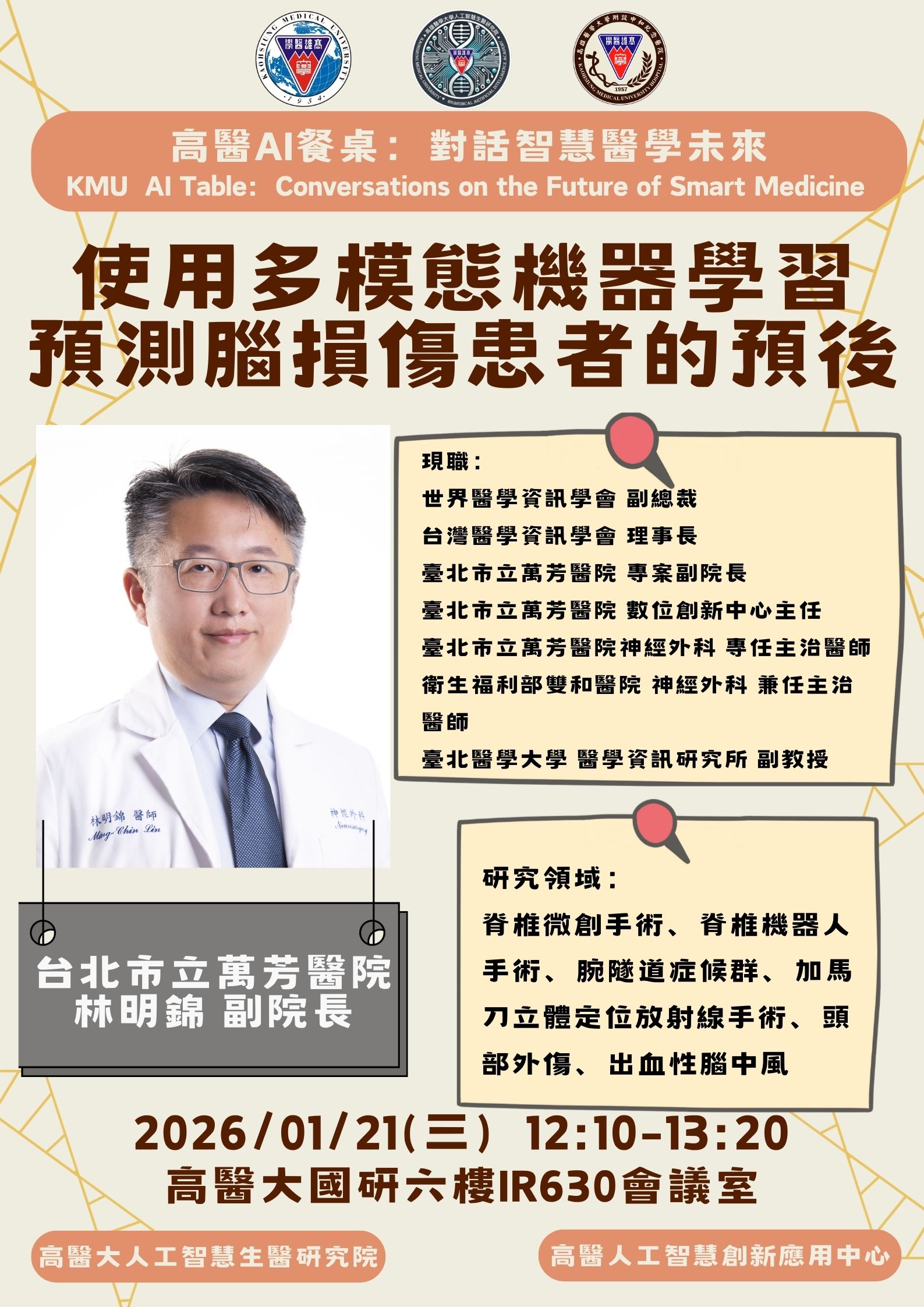
This lunchtime lecture series blends innovation, expertise, and a relaxed atmosphere, offering an exploration of the latest applications and future advancements of artificial intelligence in digital medicine. While enjoying a delicious lunch, participants will gain cutting-edge insights into AI in medicine and engage in in-depth discussions with experts.
Speakers:
- Ming-Chin Lin (Vice Superintendent, Taipei Medical University Wan-Fang Hospital)
This study, led by Dr. Ming-Chin Lin from Wan Fang Hospital, Taipei Medical University, aims to predict the prognosis of patients with brain injury using multimodal machine learning techniques. Traditionally, the assessment of consciousness in patients with brain injury has relied primarily on clinical scales such as the Glasgow Coma Scale (GCS). However, these methods have notable limitations and are often insufficient for accurately predicting whether patients will regain consciousness, the extent of recovery, or the time required for recovery.
To address these challenges, the research team developed the Brain Response Clinical Decision Support System (BRes-CDSS), which integrates Internet of Things (IoT) and artificial intelligence technologies to analyze brain activity through task-based electroencephalography (EEG). The system employs connectivity metrics such as the weighted Phase Lag Index (wPLI) and weighted Symbolic Mutual Information (wSMI) to evaluate functional connectivity between different brain regions, thereby distinguishing between conscious and unconscious states.
To date, more than 800 patients have been enrolled across multiple medical centers, including Shuang Ho Hospital, Wan Fang Hospital, National Taiwan University Hospital, and Hualien Tzu Chi Hospital. The results demonstrate that a multimodal model incorporating age, GCS, and EEG connectivity features achieves an area under the curve (AUC) of up to 0.84 in predicting six-month outcomes. In addition, the team has developed a wearable Bluetooth EEG device, advancing toward real-time clinical monitoring applications. Overall, this research provides an objective and quantitative auxiliary tool for neurological prognosis assessment in patients with brain injury.
We welcome all colleagues interested in AI and medical innovation to sign up and explore the limitless possibilities of smart medicine together!
【Lecture Information】
- Topic: Predicting Prognosis in Patients with Brain Injury Using Multimodal Machine Learning
- Date & Time: January 21, 2026 (Wed.) | 12:10-13:20
- Venue: Room IR630, 6th Floor, International Academic Research Building, Kaohsiung Medical University
- Registration Deadline: Until January 19, 2026 (Mon.) at 12:00 | Online registration required
- Registration Link: https://forms.gle/as47mdBPZzk7yYHL9
- Participation Mode: Hybrid (In-person: 60 participants; Online: Unlimited)
- Organizers: Biomedical Artificial Intelligence Academy of KMU, Medical AI Innovation and Application Center of KMUH
- Additional Info: Lunch will be provided for in-person attendees.
※ This lecture is eligible for KMU faculty growth credits. Participants must complete both sign-in/out and the satisfaction survey to receive credit points.
We look forward to your participation!